New Astronomy by Johannes Kepler
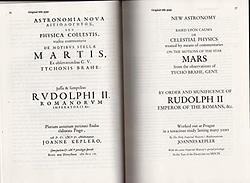
This groundbreaking work revolutionizes the understanding of celestial mechanics by introducing the concept of elliptical orbits, challenging the long-held belief in circular planetary paths. Through meticulous observations and calculations, it presents the first two of the three laws of planetary motion, laying the foundation for modern astronomy. The text delves into the intricate relationship between the sun and planets, emphasizing the role of the sun's force in governing planetary movements, and marks a pivotal shift from the geocentric models of the past to a more accurate heliocentric view of the universe.
The 4976th greatest book of all time
Ranking Details:
Our ranking system awards points to books based on their appearance and position on curated lists. Here's how it works:
Unranked Lists: For lists without specific rankings, each book receives points equivalent to the list's weight. This approach recognizes the book's inclusion on prestigious lists.
Ranked Lists: Books on ranked lists receive points in two ways:
- Base Points: Initially, every book is awarded points equal to the list's weight, acknowledging its significance.
- Bonus Points: Additionally, books earn bonus points based on their ranking. The total bonus pool, equal to 100% of the list's weight, is distributed among the books, with higher-ranked books receiving more points.
Exponential Distribution: The distribution of bonus points follows an exponential model. This means the top-ranked book (#1) receives significantly more bonus points than those further down the list (e.g., #100). Our algorithm ensures that higher placements are rewarded more generously, reflecting the achievement of a top rank on any given list.
This scoring system ensures that each book's ranking reflects both its presence on multiple lists and its positions within those lists, providing a comprehensive measure of its acclaim and popularity.
Total Points: 84
This book was first published in 1609
1 Lists
- score: 169 -- Harenberg Buch der 1000 Bücher - 2005 (Weight: 160)