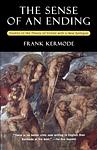
Frank Kermode
Frank Kermode was a renowned British literary critic best known for his work on Shakespeare and modern literature. He authored several influential books and essays, contributing significantly to literary theory and criticism.
Books
This list of books are ONLY the books that have been ranked on the lists that are aggregated on this site. This is not a comprehensive list of all books by this author.
-
1. The Sense Of An Ending
Studies in the Theory of Fiction
In "The Sense of an Ending," the author delves into the ways in which humans impose artificial structures and narratives on life's chaos to create a sense of order and meaning. The work explores our perception of time and our incessant need to segment it into beginnings, middles, and ends, much like the structure of a conventional story. By examining various literary and philosophical traditions, the text reveals our collective desire for resolution and how this shapes our understanding of history and our personal lives. The author argues that while this narrative ordering is a natural human impulse, it often leads to simplified and distorted perceptions of reality.
The 9008th Greatest Book of All TimePurchase from Amazon -
2. The Oxford Book Of Letters
A Collection of the Most Memorable Correspondence from the Past
This anthology is a comprehensive collection of letters spanning several centuries, curated to provide readers with a unique glimpse into the personal lives, historical events, and cultural contexts of various periods. The letters, selected for their literary merit and historical significance, offer intimate insights into the thoughts, emotions, and personalities of both renowned figures and ordinary individuals. Through these correspondences, the book not only chronicles the evolution of letter writing as an art form but also serves as a vivid tapestry of human experience, reflecting the diverse ways in which people have communicated their ideas, feelings, and experiences across time.
The 9907th Greatest Book of All TimePurchase from Bookshop.org or Amazon -
3. History And Value
The Clarendon Lectures and the Northcliffe Lectures 1987

In this insightful exploration, the author delves into the intricate relationship between history and the value we assign to literature and art. By examining how historical context influences our perception and valuation of cultural artifacts, the narrative challenges readers to reconsider the criteria by which we judge artistic worth. Through a series of thought-provoking essays, the book navigates the complex interplay between temporal context, cultural significance, and the enduring impact of creative works, ultimately questioning the permanence of value in an ever-evolving historical landscape.
Purchase from Bookshop.org -
4. The Age Of Shakespeare
This insightful exploration delves into the vibrant and transformative era of the late 16th and early 17th centuries, a period marked by the flourishing of English drama and literature. It examines the socio-political and cultural contexts that shaped the works of Shakespeare and his contemporaries, offering a nuanced understanding of the interplay between the playwrights' personal experiences and the broader historical landscape. The narrative weaves together the lives of key figures, the evolution of theatrical practices, and the enduring impact of this golden age on the literary canon, providing a comprehensive overview of a pivotal moment in literary history.
Purchase from Bookshop.org -
5. Four Centuries Of Shakespearian Criticism
A concise scholarly survey that traces four centuries of responses to Shakespeare’s plays, mapping how changing cultural, aesthetic and intellectual priorities—from Renaissance commentary and eighteenth-century neoclassicism through Romantic imagination, Victorian biographical and psychological readings to twentieth-century textual scholarship, performance studies and theoretical approaches—have reshaped interpretation. The book highlights major critical figures and debates, shows how shifts in taste, politics and scholarly method altered the plays’ meanings, and reflects on how Shakespeare’s status as a cultural touchstone has been constructed and contested. Combining close reading with historiographical analysis, it argues that criticism is both a response to the works and a mirror of the critics’ own eras.
-
6. Shakespeare's Language
A concise, readerly study of how Shakespeare uses diction, rhythm, rhetorical figures, imagery and syntactic play to shape character, advance plot and encode meaning; blending close readings with historical and philological insight, it traces recurring verbal strategies—metaphor, pun, verse-to-prose shifts, antithesis and other tropes—and shows how attention to these features illuminates performance, interpretation and the distinctive ways the plays think through language.
Purchase from Bookshop.org