Mircea Eliade
Mircea Eliade was a Romanian historian of religion, fiction writer, philosopher, and professor at the University of Chicago. He is known for his work on the nature of religious experience and the history of religions.
Books
This list of books are ONLY the books that have been ranked on the lists that are aggregated on this site. This is not a comprehensive list of all books by this author.
-
1. Bengal Nights
La Nuit Bengali (transl. Bengal Nights) is a 1933 Romanian novel written by the author and philosopher Mircea Eliade. It is a fictionalized account of the love story between Eliade, who was visiting India at the time, and the young Maitreyi Devi (protégée of the great Bengali poet Rabindranath Tagore, who became a famous writer herself). The novel was translated into Italian in 1945, German in 1948, Spanish in 1952, Bengali in 1988, Esperanto in 2007 (as Fraŭlino Maitreyi as part of the Serio Oriento-Okcidento), Catalan in 2011, Georgian in 2019, and Albanian in 2022. Its most famous translation is the one in French, published as La Nuit Bengali in 1950. For many years, Maitreyi Devi was not aware that the story had been published. After reading it, she wrote her own version of the relationship in 1974. Entitled Na Hanyate, it was originally published in Bengali. It was published in English as It Does Not Die. In fulfillment of a promise Eliade made to Maitreyi that his novel would not be published in English during their lifetimes, an English translation, of Mayitreyi, Bengal Nights did not appear until 1993. In 1994, the University of Chicago Press published the two works in English as companion volumes.
The 3954th Greatest Book of All TimePurchase from Bookshop.org or Amazon -
2. Proză Fantastică

The book is a collection of fantastical short stories that delve into the mystical and the supernatural, exploring themes of time, destiny, and the intersection of the mundane with the extraordinary. Through richly woven narratives, the stories often blur the lines between reality and illusion, inviting readers into a world where myth and modernity coexist. The characters frequently encounter mysterious events and entities that challenge their perceptions and beliefs, leading to profound transformations and insights. The collection reflects a deep engagement with philosophical and existential questions, presented through the lens of Romanian folklore and Eliade's unique narrative style.
The 3954th Greatest Book of All Time -
3. The Myth Of The Eternal Return
Cosmos and History
This thought-provoking work delves into the concept of cyclical time and the human desire to reconnect with the sacred through rituals and myths. It explores how ancient societies perceived time not as a linear progression but as a series of recurring cycles, where historical events are reenacted to restore cosmic order and meaning. The book examines the symbolic significance of these rituals and their role in transcending the mundane, offering a profound insight into the universal quest for renewal and the eternal return to a primordial state of being.
The 4688th Greatest Book of All TimePurchase from Bookshop.org or Amazon -
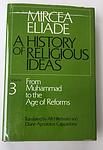
4. A History Of Religious Ideas, Volume 3
From Muhammad to the Age of Reforms
The book explores the evolution of religious ideas from the time of Muhammad to the age of the Reformation, examining the development and transformation of religious thought across various cultures and regions. It delves into the rise of Islam, the mystical traditions of the Middle Ages, and the impact of the Renaissance on religious beliefs. The work highlights the interplay between religion and society, illustrating how historical events and cultural exchanges influenced spiritual practices and theological concepts. Through a comprehensive analysis, it provides insights into the complex tapestry of religious history during this transformative period.
The 4722nd Greatest Book of All TimePurchase from Amazon -
5. Images And Symbols
Studies in Religious Symbolism
The book is a profound exploration of the symbolism inherent in religious images, myths, and rituals. It delves into the various ways in which symbols function within different cultures, examining their role in expressing the metaphysical dimension of reality. The author argues that symbols are integral to human experience, allowing individuals to transcend the ordinary world and connect with a deeper, universal level of consciousness. Through an analysis of diverse religious traditions and artistic expressions, the work reveals how symbols serve as a bridge between the sacred and the profane, offering insights into the human quest for meaning and the spiritual dimension of life.
The 5037th Greatest Book of All TimePurchase from Bookshop.org or Amazon -
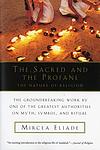
6. The Sacred And The Profane
The Nature of Religion
"The Sacred and the Profane" explores the concept of human experience of the sacred, contrasting it with the profane world of everyday life. The author delves into various religious practices and beliefs to illustrate how traditional societies have structured their worldviews and environments through religious symbolism and myth. By examining sacred spaces, time, and nature, the book reveals how the sacred elevates and enriches human life, providing a sense of meaning and orientation. The analysis highlights the universal human tendency to seek connections with a transcendent reality, thereby separating and distinguishing the sacred from the ordinary.
The 10309th Greatest Book of All TimePurchase from Bookshop.org or Amazon -
7. Domnisoara Christina. Sarpele
Sarpele
The book is a haunting exploration of the supernatural, delving into the eerie and the uncanny through the story of a mysterious woman who haunts a Romanian family. With a narrative that weaves between the boundaries of the living and the dead, the book examines themes of love, obsession, and the cultural folklore of vampirism. The protagonist's encounter with the enigmatic Christina and the subsequent unraveling of reality challenge the reader to confront the power of ancient myths and the darkness that lies within the human psyche.
The 17025th Greatest Book of All Time -
8. A History Of Religious Ideas, Volume 1
From the Stone Age to the Eleusinian Mysteries
This book provides a comprehensive exploration of the development of religious beliefs and practices from prehistoric times to the ancient civilizations of the Near East, India, and China. It examines the evolution of religious ideas, highlighting the ways in which early humans sought to understand and interact with the sacred. The text delves into the origins of shamanism, the emergence of polytheistic and monotheistic systems, and the foundational myths and rituals that shaped early spiritual life. Through a detailed analysis of archaeological findings and historical records, the book offers insights into the complex interplay between religion, culture, and society in shaping human history.
The 17172nd Greatest Book of All Time -
9. A History Of Religious Ideas, Volume 2
From Gautama Buddha to the Triumph of Christianity
This volume delves into the evolution of religious ideas from the time of the Buddha to the spread of Christianity. It explores the development and transformation of religious beliefs and practices across various cultures and regions, including the rise of Hinduism, the philosophical advancements in Greece, and the religious dynamics within the Roman Empire. The book examines the interplay between different religious traditions and the socio-political contexts that influenced their growth, offering insights into the complex tapestry of human spirituality and the enduring quest for meaning.
The 17172nd Greatest Book of All Time -
10. Le Roman De L'adolescent Myope
The novel explores the introspective journey of a myopic adolescent navigating the complexities of adolescence in early 20th-century Romania. Through the protagonist's eyes, readers experience his struggles with self-identity, intellectual aspirations, and the tumultuous emotions of youth. The narrative delves into his interactions with family, friends, and romantic interests, capturing the essence of youthful idealism and the quest for meaning in a rapidly changing world. The story is a poignant reflection on the universal challenges of growing up and the search for one's place in society.
-
11. Secretul Doctorului Honigberger. Nopţi La Serampore
The book weaves together two intriguing stories that explore themes of mysticism and the supernatural. In the first story, a scholar becomes obsessed with uncovering the secrets of a mysterious doctor who is rumored to have discovered the key to immortality. As he delves deeper into the doctor's enigmatic past, he encounters strange phenomena that blur the lines between reality and the mystical. The second story follows a group of friends who experience a series of inexplicable events during their nights in Serampore, India, leading them to question the nature of time and existence. Both tales are rich with philosophical reflections and delve into the intersection of Eastern and Western spiritual traditions.
-
12. Shamanism
Archaic Techniques of Ecstasy
The book explores the complex and diverse practices of shamanism across various cultures and historical periods, highlighting its role as a spiritual and religious phenomenon. It delves into the shaman's journey, rituals, and the symbolic meanings behind their practices, emphasizing the shaman's ability to mediate between the human and spiritual worlds. Through a comparative analysis, the book examines the universal elements of shamanic traditions, such as trance states, initiation rites, and the use of sacred symbols, while also acknowledging the unique aspects of shamanism in different cultural contexts.
-
13. Myth And Reality
The Search for the Center
This insightful work delves into the intricate relationship between myth and reality, exploring how myths shape human perception and understanding of the world. It examines the role of myths in various cultures, emphasizing their function as a means of connecting the sacred and the profane. The text argues that myths are not mere stories but are essential frameworks that provide meaning and structure to human existence, influencing both individual and collective consciousness. Through a comparative analysis, it highlights the universal themes present in myths across different societies, underscoring their enduring significance in shaping cultural and spiritual life.
-
14. Ocultism, Vrăjitorie și Mode Culturale
A compact, scholarly examination of modern occultism and witchcraft that situates esoteric movements within broader cultural and historical currents, arguing that contemporary interest in magic and the occult reflects transformed continuities of archaic religious forms; it analyzes rituals, symbols, and the experience of the sacred, and considers the social, psychological, and intellectual forces—including reactions to modernity and nationalism—that shape and sustain these phenomena.
-
15. La ţigănci
A lonely, middle-aged man wandering the streets of Bucharest one night is drawn into a mysterious house of gypsy women where reality slips into a dreamlike realm; confronted with erotic visions, echoes of past loves and childhood memories, he experiences strange distortions of time and identity that gradually erode his sense of self, producing an ambiguous, mythic conclusion in which memory, desire and the supernatural merge.
-
-
17. Rites And Symbols Of Initiation
The Mysteries of Birth and Rebirth
A comparative study of initiation rituals across cultures that traces the symbolic grammar of rites of passage—separation, liminality, and incorporation—and shows how myths, ceremonial deaths and rebirths, ordeals, purification, secret teachings, and sacred time and space enact personal transformation and social integration; the work interprets recurrent motifs (water, fire, blood, masks, descent) as metaphors for psychic and cosmic renewal and argues that initiation functions to resolve existential transitions, legitimize authority, and bind individuals into communal and religious orders.
Purchase from Bookshop.org -
18. The Forge And The Crucible
The Origins and Structures of Alchemy
A comparative study of metalworking, alchemy, and the figure of the smith that traces how forging and smelting became powerful cosmological and religious metaphors across cultures; drawing on myth, ritual, folklore, and historical sources, it argues that the forge and the crucible embodied themes of creation, transformation, death and rebirth, and mediated human contact with sacred powers, while craftsmen often occupied liminal, ambivalent social and spiritual roles.
Purchase from Bookshop.org -
19. Yoga
Essai sur les origines de la mystique indienne
A compact historical and phenomenological study of Indian yoga traditions that traces their development, philosophical foundations (Sāṃkhya, Vedānta and related systems), and technical practices—āsana, prāṇāyāma, meditation and samādhi—as means to spiritual liberation; it situates classical and tantric forms in their ascetic and ritual contexts and interprets yoga as a practical program for overcoming ordinary temporal existence and achieving immortality or freedom.