Leonard Susskind
Leonard Susskind is a renowned American theoretical physicist, known for his contributions to string theory, quantum field theory, and the holographic principle. He is a professor of theoretical physics at Stanford University and has authored several popular science books.
Books
This list of books are ONLY the books that have been ranked on the lists that are aggregated on this site. This is not a comprehensive list of all books by this author.
-
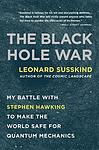
1. The Black Hole War
My Battle with Stephen Hawking to Make the World Safe for Quantum Mechanics
"The Black Hole War" is a captivating exploration of the fierce scientific debate between Stephen Hawking and Leonard Susskind over the nature of black holes and the fate of information that falls into them. The book delves into the principles of quantum mechanics and general relativity, which seemed to be at odds in the context of black holes. Susskind argues against Hawking's initial claim that information swallowed by black holes is forever lost to the universe, proposing instead that this would violate the fundamental laws of quantum mechanics. The narrative chronicles Susskind’s journey to defend the conservation of information, leading to a profound shift in our understanding of black holes, culminating in the acceptance of the holographic principle which reconciles the theories in question.
The 17165th Greatest Book of All TimePurchase from Amazon -
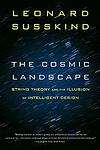
2. The Cosmic Landscape
String Theory and the Illusion of Intelligent Design
"The Cosmic Landscape" explores the fascinating concept of the multiverse and string theory, presenting the idea that our universe is just one of many possible universes described by the laws of physics. The book delves into the implications of this theory, discussing how it addresses deep questions about the nature of reality and the fine-tuning of the universe for life. Through accessible language, the author explains complex scientific principles and argues for a paradigm shift in our understanding of the cosmos, suggesting that what we perceive as the "natural order" is actually an outcome of random processes playing out across a vast cosmic landscape of possibilities.
The 17165th Greatest Book of All TimePurchase from Bookshop.org or Amazon -
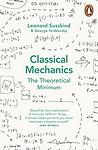
3. Classical Mechanics
The Theoretical Minimum
This book provides a comprehensive introduction to classical mechanics, exploring the fundamental principles of Newtonian physics. Through a detailed examination of topics such as dynamics, conservation laws, the theory of relativity, and Hamiltonian and Lagrangian mechanics, the text equips readers with the tools necessary to understand and predict the motion of particles and systems. The authors emphasize a theoretical approach, using mathematics to formulate physical principles precisely and to solve problems systematically, making it an essential resource for students and enthusiasts eager to deepen their understanding of the physical world.
The 17165th Greatest Book of All TimePurchase from Amazon -
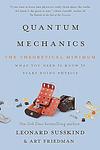
4. Quantum Mechanics
The Theoretical Minimum
This book serves as an engaging and accessible introduction to the complex world of quantum mechanics, unraveling the mysteries of the quantum realm with clarity and precision. It explores fundamental concepts such as wave functions, quantum states, and the principles of superposition and entanglement, while also delving into the mathematical frameworks that underpin these ideas. Through a series of thought-provoking lectures, the reader is guided through the intricacies of quantum theory, making it an invaluable resource for both students and enthusiasts eager to understand the quantum nature of our universe.
Purchase from Bookshop.org -
5. Introduction To Black Holes, Information And The String Theory Revolution, An
The Holographic Universe
This book delves into the intriguing intersection of black holes, quantum mechanics, and string theory, exploring the profound implications these concepts have on our understanding of the universe. It addresses the paradox of information loss in black holes and how string theory offers potential resolutions, challenging traditional notions of space and time. Through a blend of theoretical physics and thought experiments, the text provides a comprehensive overview of how these revolutionary ideas are reshaping our comprehension of the cosmos and the fundamental laws that govern it.
-
6. The Theoretical Minimum
What You Need to Know to Start Doing Physics
This book serves as an accessible introduction to the fundamental concepts of theoretical physics, designed for those who wish to grasp the core principles without delving into overly complex mathematics. It covers essential topics such as classical mechanics, quantum mechanics, and relativity, providing readers with the "minimum" knowledge required to understand the theoretical framework that underpins modern physics. Through clear explanations and practical examples, it bridges the gap between popular science literature and more advanced academic texts, making it an ideal resource for curious minds eager to explore the universe's underlying laws.
Purchase from Bookshop.org -
7. The Future Of The Professions
How Technology Will Transform the Work of Human Experts

This insightful book explores the transformative impact of technology on traditional professions, arguing that the advancement of artificial intelligence and digital platforms is reshaping the way professional services are delivered. It delves into how these changes are democratizing access to expertise, challenging the conventional roles of professionals, and prompting a shift towards more collaborative and innovative models of service delivery. The authors provide a compelling analysis of the implications for education, law, healthcare, and other fields, urging professionals to adapt to this evolving landscape to remain relevant in the future.
Purchase from Bookshop.org -
8. Three Lectures On Complexity And Black Holes
A concise exploration of how quantum computational complexity illuminates black hole dynamics and holography, introducing circuit complexity for many-body quantum states and proposing a “second law of complexity” that provides an arrow of time. It connects the linear growth of complexity to the expansion of wormhole interiors through the complexity=volume/action ideas, and examines scrambling, shockwaves, and switchbacks. Through thought experiments like Hayden–Preskill, it clarifies the practical limits on decoding information from Hawking radiation and the implications for the information paradox and ER=EPR.
Purchase from Bookshop.org -
9. Special Relativity And Classical Field Theory
The Theoretical Minimum
A concise, accessible introduction to spacetime geometry and Lorentz invariance that builds the tools of four-vectors and tensors, develops the covariant formulation of electromagnetism, and uses the action principle and Lagrangian densities to derive classical field equations. It emphasizes symmetries and Noether’s theorem, constructs the energy-momentum tensor, and explores gauge invariance and the structure of Maxwell’s equations, with clear examples and exercises that prepare readers for more advanced study, including quantum field theory.
-
10. Growth
null
-
11. Future Politics
Living Together in a World Transformed by Tech
An accessible, provocative examination of how rapidly advancing technologies—artificial intelligence, big data, biotechnology, and ubiquitous surveillance—are reshaping power, privacy, and democracy. It argues that technical capabilities will enable unprecedented concentration of control by states and corporations unless new political institutions, legal frameworks, and public awareness are developed; explores scenarios in which algorithms and engineered biology change incentives, behaviors, and inequalities; and stresses the need for democratic oversight, transparency, and collective choices to preserve individual freedom and social justice.