Henry A. Kissinger
Henry Alfred Kissinger is an American diplomat, political scientist, and geopolitical consultant who served as United States Secretary of State and National Security Advisor under the presidential administrations of Richard Nixon and Gerald Ford. He played a significant role in U.S. foreign policy between 1969 and 1977, including pioneering efforts in détente with the Soviet Union, opening relations with the People's Republic of China, and negotiating the Paris Peace Accords, which ended American involvement in the Vietnam War.
Books
This list of books are ONLY the books that have been ranked on the lists that are aggregated on this site. This is not a comprehensive list of all books by this author.
-
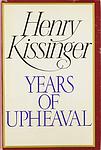
1. Years Of Upheaval
The Second Volume of His Classic Memoirs
"Years of Upheaval" is a detailed and introspective account of the author's tenure as the U.S. Secretary of State during the tumultuous years of the early 1970s. The book delves into the complexities of international diplomacy and political maneuvering during a period marked by the winding down of the Vietnam War, the historic 1973 Yom Kippur War in the Middle East, and the consequential peace negotiations that followed. It also explores the intricate dynamics of U.S.-Soviet relations and the strategic arms limitation talks, providing a deep insight into the challenges and intricacies of Cold War diplomacy, all set against the backdrop of domestic political upheaval and the Watergate scandal.
The 11663rd Greatest Book of All TimePurchase from Bookshop.org or Amazon -
2. Diplomacy
None
This comprehensive exploration of international relations delves into the intricate web of diplomacy that has shaped global politics over the centuries. It examines the strategies and decisions of key historical figures, from Richelieu to Nixon, and how their actions have influenced the balance of power across nations. The narrative provides insights into the complex interplay of national interests, ideological conflicts, and the pursuit of peace, offering a nuanced understanding of the art and practice of diplomacy in a constantly evolving world.
The 17165th Greatest Book of All TimePurchase from Bookshop.org or Amazon -
3. World Order
Reflections on the Character of Nations and the Course of History
The book explores the concept of world order by examining historical and contemporary geopolitical dynamics. It delves into how different cultures and nations have approached international relations and the balance of power throughout history. The author analyzes the evolution of global political systems and the challenges posed by modern conflicts, technological advancements, and ideological shifts. By drawing on historical examples and diplomatic insights, the book offers a comprehensive analysis of the complexities involved in establishing a stable and cooperative global order.
-
4. The Age Of Ai And Our Human Future
And Our Human Future
In this thought-provoking exploration, the authors delve into the profound implications of artificial intelligence on society, politics, and human identity. They examine how AI is reshaping the landscape of global power, challenging traditional notions of governance, and altering the fabric of human interaction. Through a blend of historical context and futuristic insight, the book raises critical questions about the ethical and philosophical dimensions of AI, urging readers to consider the balance between technological advancement and the preservation of human values. It serves as a call to action for thoughtful engagement with the rapidly evolving digital world.
-
5. Issues On My Mind
Strategies for the Future

This insightful collection of essays delves into the complex geopolitical landscape of the 21st century, offering a seasoned diplomat's perspective on pressing global issues. The author reflects on the challenges of international diplomacy, the evolving nature of global power dynamics, and the intricate interplay between technology and security. With a focus on historical context and strategic foresight, the essays provide a nuanced understanding of how past experiences can inform future policy decisions, emphasizing the importance of thoughtful leadership in navigating an increasingly interconnected world.
-
6. On China
This insightful work delves into the intricate history and complex relationship between China and the Western world, particularly the United States. It explores the evolution of Chinese diplomacy and strategic thinking, tracing back to ancient times and highlighting key historical events that have shaped modern China's foreign policy. The narrative provides a unique perspective on China's rise as a global power, offering a blend of historical analysis and personal anecdotes from the author's experiences in diplomacy, ultimately emphasizing the importance of understanding China's cultural and political landscape to foster better international relations.
Purchase from Bookshop.org -
7. Leadership
Six Studies in World Strategy
This insightful work delves into the intricate dynamics of leadership through the lens of historical figures and pivotal moments in global politics. It explores the qualities and strategies that define effective leadership, drawing lessons from the successes and failures of prominent leaders. The narrative weaves together historical analysis with personal anecdotes, offering a nuanced perspective on the challenges and responsibilities that come with wielding power. Through a blend of historical context and philosophical reflection, it provides a comprehensive examination of what it takes to lead in an ever-evolving world.
Purchase from Bookshop.org -
8. A World Restored
Metternich, Castlereagh and the Problems of Peace, 1812-22
This insightful analysis delves into the intricate dynamics of European diplomacy during the post-Napoleonic era, focusing on the efforts to establish a stable international order. It examines the roles of key figures such as Metternich and Castlereagh, who navigated the complex interplay of power, ideology, and national interests to craft a balance of power that would endure for decades. Through a detailed exploration of the Congress of Vienna and its aftermath, the narrative highlights the challenges and successes of restoring peace and stability in a continent ravaged by years of conflict.
Purchase from Bookshop.org -
9. Sobre A China
A concise blend of history and firsthand diplomacy that explores how China’s strategic culture—from classical statecraft to revolutionary upheaval—has shaped its foreign policy. It traces the legacy of the “century of humiliation,” civil war, and the Sino‑Soviet split through the secret negotiations that paved the way for rapprochement with the United States and subsequent normalization. The narrative highlights how leaders such as Mao, Zhou, and Deng balanced ideology with pragmatism and concludes by assessing the prospects for managing competition and cooperation in twenty‑first‑century great‑power relations.
-
-
11. Orden Mundial
Reflections on the Character of Nations and the Course of History
A sweeping historical and strategic analysis that traces how different civilizations and eras—from the Peace of Westphalia through 19th-century Europe to contemporary America, China, and the Islamic world—have conceived of and tried to create international order; it examines the philosophical and cultural roots of competing state systems, the pressures of nationalism, technology and weapons of mass destruction, and the crises that expose the limits of existing arrangements, arguing that careful diplomacy, clear principles, and realistic balance-of-power strategies are required to manage rising powers and preserve a stable global order.
-
12. Die Sechs Säulen Der Weltordnung
Die Darstellung analysiert die historischen Grundlagen und verschiedenen kulturellen Modelle, die internationale Ordnung ermöglichen, und zeigt, wie Machtbalance, Legitimität, nationale Identitäten und diplomatisches Geschick miteinander verwoben sind; sie warnt vor den Gefahren von einseitiger Hegemonie und Isolationismus, betont die Notwendigkeit pragmatischer Führung und multilateraler Abstimmung und plädiert dafür, dass stabile Weltordnung nur durch ein Zusammenspiel von Macht, Recht und verständnisvoller Diplomatie in einer zunehmend multipolaren Welt bewahrt werden kann.