Martin Gardner
Martin Gardner was an American popular mathematics and science writer, known for his work in recreational mathematics and his long-running column 'Mathematical Games' in Scientific American. He was also a critic of pseudoscience and a prolific author of books on a wide range of topics.
Books
This list of books are ONLY the books that have been ranked on the lists that are aggregated on this site. This is not a comprehensive list of all books by this author.
-
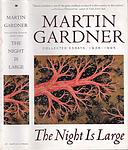
1. The Night Is Large
Collected Essays, 1938-1995
The book is a comprehensive collection of essays that explore a wide range of topics across science, mathematics, philosophy, and literature. It reflects the author's deep curiosity and intellectual rigor, offering insights into subjects such as the nature of scientific inquiry, the beauty of mathematical puzzles, and the interplay between science and pseudoscience. Through clear and engaging prose, the author invites readers to ponder complex ideas and appreciate the wonders of the natural world, while also critiquing the misuse of science and championing rational thought.
The 17175th Greatest Book of All TimePurchase from Amazon -
2. ¡Ajá! Paradojas Que Hacen Pensar
Paradojas Que Hacen Pensar

A lively collection of short puzzles, paradoxes and brainteasers that expose counterintuitive results in logic, mathematics and probability, each presented with clear explanation and commentary to reveal why our intuitions fail and how to think more carefully. The book mixes playful examples, historical anecdotes and step-by-step solutions to entertain readers while sharpening their reasoning and curiosity about seemingly simple but surprising problems.
-
3. The Colossal Book Of Mathematics
A sprawling anthology of engaging essays and puzzles that collects decades of popular recreational mathematics writing, presenting clever problems, paradoxes, visual puzzles, number tricks, geometric curiosities, and accessible expositions of topics from topology, combinatorics, and number theory; it blends historical anecdotes with clear, playful explanations and solutions, designed to delight both curious lay readers and seasoned problem-solvers while showcasing the creative thinking and surprises that make mathematics fun.
Purchase from Bookshop.org -
4. Fractal Music, Hypercards & More Mathematical Recreations From Scientific American
Mathematical Recreations From Scientific American
A lively collection of accessible essays drawn from Scientific American that explores mathematical curiosities and recreational topics—from the visual beauty and construction of fractals to the mathematics of music and algorithmic composition, the playful uses of early personal-computer tools like HyperCard, and a variety of puzzles, paradoxes, and games—each piece blending clear explanations, historical asides, and hands-on examples that invite general readers to experiment and think creatively about mathematics.
-
5. Fractal Music, Hypercards & More Mathematical Recreations From Scientific American Magazine
Mathematical Recreations From Scientific American Magazine
A lively collection of accessible essays drawn from a popular magazine column that explores recreational mathematics and its offshoots — from the visual and musical patterns of fractals to algorithmic curiosities, puzzles, games, computer experiments (including HyperCard-style projects) and paradoxes — all presented with clear exposition, historical asides, and playful demonstrations that invite readers to experiment and think creatively about mathematical ideas.
-
Purchase from Bookshop.org