Julian Rubinstein
Julian Rubinstein is an author and journalist known for his works that often explore complex social issues and true crime. His notable works include 'Ballad of the Whiskey Robber' and 'The Holly: Five Bullets, One Gun, and the Struggle to Save an American Neighborhood.'
Books
This list of books are ONLY the books that have been ranked on the lists that are aggregated on this site. This is not a comprehensive list of all books by this author.
-
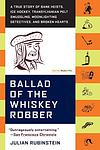
1. Ballad Of The Whiskey Robber
A True Story of Bank Heists, Ice Hockey, Transylvanian Pelt Smuggling, Moonlighting Detectives, and Broken Hearts
Set against the backdrop of post-Communist Hungary, this riveting true story follows the audacious exploits of Attila Ambrus, a charismatic and elusive bank robber who became a folk hero. Known for his gentlemanly demeanor and penchant for whiskey, Ambrus's escapades captivated the nation as he outwitted the police time and again, leaving behind a trail of daring heists and a perplexed law enforcement. Blending humor, suspense, and a touch of melancholy, the narrative delves into the socio-economic upheavals of the era, painting a vivid portrait of a man who became a symbol of rebellion and resilience in a rapidly changing world.
-
3. Economics And Language
Five Essays

A collection of essays exploring the deep interplay between economic modeling and language, arguing that models function as linguistic devices rather than literal descriptions of reality. It examines how meaning, conventions, and communication shape strategic interaction and equilibrium concepts, draws insights from bargaining and experimental settings, and underscores the limits of formalism while advocating a modest, context-sensitive approach to economic reasoning.
-
4. Modeling Bounded Rationality
A concise exploration of how economic and strategic behavior can be modeled when decision makers face limits on calculation, memory, and reasoning. It develops simple formal tools—such as finite automata, similarity-based choice, and costs of deliberation—to capture procedures people actually use rather than assuming flawless optimization. The book illustrates how these models can explain cooperation, mistakes, and systematic patterns in choices, while advocating for transparent, modest theories grounded in realistic cognitive processes.