Paul Watzlawick
Paul Watzlawick was an Austrian-American psychologist and philosopher, known for his work in communication theory and radical constructivism. He was a prominent figure at the Mental Research Institute in Palo Alto, California, and contributed significantly to the fields of family therapy and communication.
Books
This list of books are ONLY the books that have been ranked on the lists that are aggregated on this site. This is not a comprehensive list of all books by this author.
-
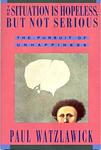
1. The Situation Is Hopeless, But Not Serious
The Pursuit of Unhappiness
This insightful book delves into the paradoxes of human behavior and the self-imposed traps that often lead to unnecessary suffering. Through a blend of humor and psychological insight, it explores how individuals create and perpetuate their own problems by clinging to rigid perceptions and ineffective solutions. The narrative encourages readers to embrace flexibility and humor as tools for navigating life's challenges, ultimately suggesting that while situations may seem dire, a shift in perspective can reveal unexpected opportunities for growth and happiness.
The 4523rd Greatest Book of All TimePurchase from Bookshop.org or Amazon -
2. Anleitung Zum Unglücklichsein

A witty, paradoxical psychological guide that demonstrates how people unwittingly create and perpetuate their own unhappiness through distorted thinking, rigid expectations, blaming, and constant comparison; using short anecdotes and ironic 'instructions,' it exposes common self-defeating patterns and invites readers to recognize and abandon them to live more freely.
The 17153rd Greatest Book of All TimePurchase from Bookshop.org -
3. A Realidade é Real?
Confusão, Desilusão e a Arte de Viver
This insightful work delves into the intricate nature of human perception and the subjective construction of reality. It explores how individuals interpret their surroundings through a personal lens, influenced by cultural, social, and psychological factors. The book challenges the notion of an objective reality, proposing that what we perceive as "real" is often a complex interplay of beliefs, assumptions, and interpretations. Through a series of thought-provoking examples and analyses, it invites readers to question their own perceptions and consider the fluidity of reality in everyday life.
-
4. Pragmatics Of Human Communication
A Study of Interactional Patterns, Pathologies, and Paradoxes
This seminal work explores the intricate dynamics of human communication, emphasizing the role of context, relationships, and non-verbal cues in shaping interactions. It delves into the concept that communication is not just about the exchange of information but is a complex process that involves interpreting meanings and intentions. The book introduces the idea that every communication act is part of a larger system, where each participant's behavior influences and is influenced by others, highlighting the importance of understanding these patterns to improve interpersonal relationships and resolve conflicts.
-
5. Change
Principles of Problem Formation and Problem Resolution
This insightful work delves into the intricacies of human behavior and the mechanisms of change, exploring how individuals and systems can transform through shifts in perception and communication. It presents a compelling analysis of the paradoxes and patterns that often hinder progress, offering practical strategies for overcoming these barriers. By examining the dynamics of change from a psychological and systemic perspective, the book provides readers with a deeper understanding of how to facilitate meaningful and lasting transformation in both personal and professional contexts.
Purchase from Bookshop.org -
6. Münchhausens Zopf
An exploration of how people fabricate and sustain self-deceptive narratives to organize experience and avoid anxiety, this work uses the Münchhausen metaphor to analyze the dynamics of therapeutic interaction. Combining case vignettes with constructivist theory, it shows how patients' narratives shape their perceived reality, how therapists can inadvertently reinforce maladaptive patterns, and how shifts in communication and framing can open paths to change. The text highlights paradox, circularity, and the pragmatic use of language in clinical practice, offering both critical reflection and practical guidance for psychotherapy.
Purchase from Bookshop.org