Werner Heisenberg
Werner Heisenberg was a German theoretical physicist and one of the key pioneers of quantum mechanics. He is best known for the development of the Heisenberg uncertainty principle, which states that the position and the momentum of a particle cannot both be precisely determined at the same time.
Books
This list of books are ONLY the books that have been ranked on the lists that are aggregated on this site. This is not a comprehensive list of all books by this author.
-
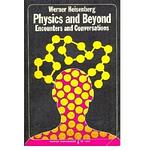
1. Physics And Beyond
Encounters and Conversations
The book is a reflective exploration of the development of quantum mechanics and the philosophical implications of scientific discoveries. Through a series of dialogues and personal anecdotes, the author delves into the interplay between science and philosophy, highlighting the uncertainty and complexity inherent in understanding the natural world. The narrative captures the intellectual atmosphere of the early 20th century, featuring discussions with prominent physicists and thinkers, and emphasizes the importance of creativity and intuition in scientific inquiry.
The 2884th Greatest Book of All TimePurchase from Amazon -
2. Uncertainty Principle
"Uncertainty Principle" is a seminal work in quantum mechanics that explores the concept that it's impossible to simultaneously measure the exact position and momentum of a particle. This principle has profound implications for our understanding of the physical world, challenging traditional notions of cause and effect and deterministic laws of physics. The book details the development, interpretation, and implications of this principle, providing a comprehensive overview of one of the most fundamental concepts in quantum physics.
The 15916th Greatest Book of All TimePurchase from Amazon -
3. Physics and Philosophy
The Revolution in Modern Science
"Physics and Philosophy" is a comprehensive exploration of the intersection between physics and philosophy, primarily focusing on quantum theory. The author, a Nobel laureate, delves into the philosophical implications of quantum mechanics, examining the shift from deterministic to probabilistic models in physics. The book also discusses the nature of reality, the limits of scientific knowledge, and the role of language in describing physical phenomena, offering a nuanced perspective on the philosophical questions raised by advances in modern physics.
The 17162nd Greatest Book of All TimePurchase from Amazon -
4. Quantentheorie Und Philosophie

A concise exploration of the conceptual foundations and philosophical implications of quantum mechanics, examining how discoveries like the uncertainty principle and complementarity reshape traditional notions of causality, reality, and objectivity. The book argues that quantum theory forces a rethink of the relationship between observation and the properties of physical systems, highlights limits to classical descriptions, and considers the roles of language and mathematical formalism in framing scientific knowledge. It connects technical results to broader epistemological and metaphysical questions about what can be known and how scientific concepts must adapt.