B. F. Skinner
B. F. Skinner was an American psychologist, behaviorist, author, inventor, and social philosopher. He was a professor of psychology at Harvard University from 1958 until his retirement in 1974. Skinner is known for his work on operant conditioning and for his invention of the Skinner box.
Books
This list of books are ONLY the books that have been ranked on the lists that are aggregated on this site. This is not a comprehensive list of all books by this author.
-
1. Walden Two
"Walden Two" is a utopian novel that presents an experimental community where happiness, productivity, and quality of life are the main goals. The community is guided by the principles of behavioral science, and it emphasizes the importance of cultural and environmental conditioning in shaping human behavior. The book explores the idea of an ideal society, free from the problems of modern civilization, through the eyes of a professor and his two ex-students who visit the community.
The 3868th Greatest Book of All TimePurchase from Bookshop.org or Amazon -
2. Beyond Freedom and Dignity
This book is a controversial exploration of human behavior that challenges the idea of free will and individual autonomy, arguing instead that human behavior is largely determined by environmental factors. The author proposes that societal issues such as overpopulation, war, and pollution can be addressed by using behavioral science to shape human actions. The book also criticizes traditional notions of punishment and reward, suggesting that these methods are ineffective in influencing behavior.
The 14985th Greatest Book of All TimePurchase from Amazon -
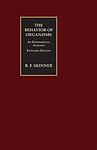
3. The Behavior Of Organisms
An Experimental Analysis
The book presents a comprehensive analysis of behavior through the lens of experimental research, focusing on the principles of operant conditioning. It explores how behavior is influenced by environmental stimuli and the consequences that follow, emphasizing the role of reinforcement in shaping and maintaining behavior. The work systematically documents various experiments and observations, providing a foundation for understanding behavior as a subject of natural science. Through meticulous study, it lays the groundwork for behavior analysis, highlighting the predictability and control of behavior through scientific methods.
-
4. Science And Human Behavior
This seminal work delves into the principles of behaviorism, exploring how human actions can be understood and predicted through scientific analysis. It presents a comprehensive examination of how environmental factors influence behavior, emphasizing the role of reinforcement and conditioning. The book argues for the application of behavioral science to solve societal issues, proposing that understanding human behavior through empirical methods can lead to more effective interventions in education, therapy, and social policy. It challenges traditional notions of free will, suggesting that behavior is largely shaped by external stimuli and learned responses.
Purchase from Bookshop.org -
Purchase from Bookshop.org