David Markson
David Markson was an American novelist, best known for his unconventional and experimental style. His works often blur the lines between fiction and non-fiction, and he has been praised for his innovative narrative techniques.
Books
This list of books are ONLY the books that have been ranked on the lists that are aggregated on this site. This is not a comprehensive list of all books by this author.
-
1. Wittgenstein's Mistress
The novel is a stream-of-consciousness narrative from the perspective of a woman who believes she is the last human on earth. She shares her thoughts, memories, and experiences in a non-linear and often confusing manner. The narrative is filled with cultural and historical references, creating a haunting and profound exploration of loneliness, memory, and the human condition.
The 3011th Greatest Book of All TimePurchase from Bookshop.org or Amazon -
2. Vanishing Point
Not a Novel
"Vanishing Point" is a novel that defies traditional narrative structure, presenting a stream-of-consciousness collage of anecdotes, quotes, biographical sketches, and philosophical musings. The book, devoid of a conventional plot, follows an unnamed protagonist, referred to as "Author," who is compiling a manuscript of historical and literary trivia, personal reflections, and a medley of obscure facts. As the protagonist grapples with themes of mortality, art, and the act of writing itself, the novel becomes a meditation on the human condition and the elusive nature of meaning in a seemingly disconnected world. The fragmented style challenges readers to piece together coherence from the disparate elements, mirroring the protagonist's own quest for understanding and significance.
The 8634th Greatest Book of All TimePurchase from Amazon -
3. The Last Novel
This book is an unconventional narrative that eschews traditional plot and character development, instead presenting a stream of anecdotes, quotes, and musings on mortality, art, and literature. The protagonist, an elderly author, contemplates his life and the looming presence of death as he works on what he believes will be his final novel. Through a collage of fragmented thoughts and intellectual references, the text explores themes of creativity, the challenges of writing, and the solitary nature of the artistic endeavor, all while blurring the lines between the author's reality and the literary world he inhabits.
The 10914th Greatest Book of All TimePurchase from Amazon -
4. This Is Not A Novel
In this unconventional narrative, the protagonist, referred to as "Writer," embarks on a reflective journey through a series of fragmented thoughts, anecdotes, and historical references. The book defies traditional storytelling by weaving together a tapestry of literary and artistic allusions, philosophical musings, and existential reflections. Through this mosaic of seemingly disparate elements, the narrative explores themes of mortality, creativity, and the human condition, inviting readers to ponder the nature of storytelling itself and the blurred lines between fiction and reality.
-
5. Reader’s Block

In this innovative and fragmented narrative, the protagonist grapples with a profound creative paralysis, exploring the depths of literary history and existential musings. Through a series of disjointed yet interconnected vignettes, the reader is taken on a journey through the mind of a writer who is both haunted and inspired by the ghosts of literature's past. The text is a mosaic of literary references, philosophical reflections, and personal anecdotes, all woven together to form a tapestry that questions the very nature of storytelling and the act of reading itself.
Purchase from Bookshop.org -
6. Wittgensteins Mätresse
A solitary, unnamed narrator delivers a fragmented, often witty monologue cataloging memories, quotations and reflections on art, music, philosophy and history while convinced she is the last person alive. Through rapid-fire allusions, self-correction and digressive lists she meditates on language, memory, loneliness and the tenuousness of reality, revealing both erudition and deep emotional exhaustion. The result is a bleakly comic, experimental exploration of what remains of culture and meaning when human connection seems to have vanished.
-
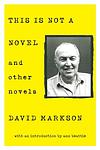
7. This Is Not A Novel And Other Novels
A tightly compressed, fragmentary, metafictional work made of laconic, aphoristic paragraphs that abandon conventional plot and character in favor of associative lists, literary anecdotes, and terse reminiscences about artists, illness, and death. Through mordant observations, quotations, and personal asides, it accumulates an elegiac, solitary meditation on aging, creativity, reading, and the limits of narrative.
Purchase from Bookshop.org -
8. Kochanka Wittgensteina
Eksperymentalna powieść w formie strumienia świadomości będąca monologiem kobiety przekonanej, że jest ostatnią istotą na Ziemi; poprzez fragmentaryczne zapiski pełne odniesień do sztuki, literatury i filozofii narratorka rekonstruuje pamięć, toczy wyimaginowane rozmowy i kwestionuje sens języka, samotności i własnej wiarygodności, tworząc ironiczny i melancholijny komentarz o granicach poznania i komunikacji.