Hubert L. Dreyfus
Hubert L. Dreyfus was an American philosopher and professor known for his work in phenomenology, existentialism, and the philosophy of artificial intelligence. He was a prominent critic of AI, arguing that human intelligence and expertise are not easily replicated by machines. Dreyfus taught at the University of California, Berkeley, and authored several influential books, including 'What Computers Can't Do' and 'Being-in-the-World: A Commentary on Heidegger's Being and Time, Division I.'
Books
This list of books are ONLY the books that have been ranked on the lists that are aggregated on this site. This is not a comprehensive list of all books by this author.
-
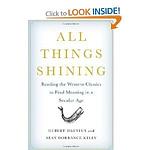
1. All Things Shining
Reading the Western Classics to Find Meaning in a Secular Age
The book explores the concept of meaning in a secular age, examining how individuals can find fulfillment and purpose in a world that often feels devoid of inherent significance. It delves into the philosophical and cultural shifts from ancient to modern times, highlighting how different eras have approached the idea of what makes life meaningful. By analyzing works of literature, philosophy, and religion, the authors argue for a return to a more engaged and appreciative way of experiencing the world, suggesting that by embracing a sense of wonder and gratitude, people can rediscover a sense of the sacred in everyday life.
-
2. Retrieving Realism
Recovering a Sense of the Real

In this thought-provoking exploration of philosophical thought, the authors delve into the ongoing debate between realism and anti-realism, challenging the prevailing Cartesian perspective that has dominated Western philosophy. They argue for a return to a more grounded understanding of human experience, drawing on the works of Heidegger, Merleau-Ponty, and Wittgenstein to propose a "retrieval" of realism that acknowledges the embodied and situated nature of human perception. By emphasizing the importance of practical engagement with the world, the book seeks to bridge the gap between the subjective and objective, offering a fresh perspective on how we interact with reality.
-
3. What Computers Still Can't Do
A Critique of Artificial Reason
A rigorous critique of early artificial intelligence research, arguing that efforts to model thought as rule-based symbol manipulation overlook the embodied, context-bound, and skillful character of human understanding. Drawing on phenomenological insights, it highlights the role of tacit know-how, background practices, and the frame problem in limiting formalization, assesses later connectionist claims, and urges approaches that prioritize situated, embodied intelligence over abstract representations.
Purchase from Bookshop.org -
4. Was Computer Nicht Können
A Critique of Artificial Reason
A concise philosophical critique of classical AI arguing that intelligence cannot be captured by rule-based symbol manipulation alone because human understanding depends on embodied, situational, and tacit know-how; drawing on phenomenology, the book explains how skill, perception, and context resist formalization and discusses the implications of these limits for AI research and cognitive science.
Purchase from Bookshop.org