Daniel Kahneman
Daniel Kahneman is a renowned psychologist and economist, notable for his work on the psychology of judgment and decision-making, as well as behavioral economics. He was awarded the Nobel Memorial Prize in Economic Sciences in 2002.
Books
This list of books are ONLY the books that have been ranked on the lists that are aggregated on this site. This is not a comprehensive list of all books by this author.
-
1. Thinking, Fast and Slow
The book delves into the two systems that drive the way we think—System 1, which is fast and intuitive, and System 2, which is slow and deliberate. The author, a Nobel laureate, explores how these systems shape our judgments and decision-making. He presents several groundbreaking experiments that have shaped our understanding of human thought, revealing where we can trust our intuitions and how we can tap into the benefits of slow thinking. The book also discusses how our cognitive biases often lead to errors in judgment and affect our decision-making processes.
The 2077th Greatest Book of All TimePurchase from Bookshop.org or Amazon -
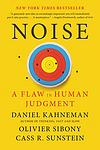
2. Noise
A Flaw in Human Judgment
In this insightful exploration of human judgment, the authors delve into the concept of "noise," the unwanted variability in decision-making that can lead to inconsistent and often unfair outcomes. They reveal how noise differs from bias, highlighting its pervasive presence across various fields, from medicine to law, and its detrimental impact on society. Through compelling examples and rigorous research, the book offers practical strategies to reduce noise, emphasizing the importance of structured decision-making processes and the implementation of noise audits to enhance accuracy and fairness in judgments.
-
3. Judgment Under Uncertainty
Heuristics and Biases

This seminal work delves into the cognitive biases and heuristics that influence human judgment and decision-making under conditions of uncertainty. It explores how people often rely on mental shortcuts that can lead to systematic errors, challenging the traditional economic assumption of human rationality. Through a series of experiments and studies, the book illustrates how these biases affect various aspects of life, from everyday decisions to significant policy-making, ultimately highlighting the need for awareness and understanding of these psychological processes to improve decision-making outcomes.
-
4. Choices, Values, And Frames
A collection of foundational research showing that human decision-making often departs from classical rational-choice models: people evaluate outcomes relative to reference points, exhibit loss aversion, overweight small probabilities, and are sensitive to how options are framed. Through experimental evidence and theoretical discussion it develops prospect theory, documents cognitive heuristics and systematic biases in risk perception and valuation, and draws implications for economics, public policy, and everyday judgment.