Jean Baudrillard
Jean Baudrillard was a French sociologist, philosopher, cultural theorist, political commentator, and photographer known for his analyses of media, contemporary culture, and technological communication, as well as his formulation of concepts such as hyperreality and simulacra.
Books
This list of books are ONLY the books that have been ranked on the lists that are aggregated on this site. This is not a comprehensive list of all books by this author.
-
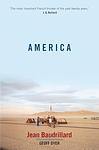
1. America
In this thought-provoking exploration, the author embarks on a journey through the vast landscapes and urban sprawls of the United States, capturing the essence of its cultural and social dynamics. Through a series of vivid observations and philosophical reflections, the narrative delves into the hyperreality of American life, where the boundaries between reality and illusion blur. The work offers a critical examination of the American dream, consumerism, and the unique blend of freedom and isolation that characterizes the nation's identity, inviting readers to question the very nature of modern civilization.
The 6806th Greatest Book of All TimePurchase from Bookshop.org or Amazon -
2. Simulacres Et Simulation
This thought-provoking work delves into the concept of hyperreality, where the boundaries between reality and simulation blur, leading to a world dominated by signs and symbols that no longer refer to anything real. The author explores how contemporary society is increasingly engulfed by simulacra, representations that replace and distort the original reality, creating a new realm where the distinction between the real and the imaginary becomes indistinguishable. Through a series of essays, the book examines the implications of this phenomenon on culture, media, and human perception, challenging readers to reconsider their understanding of reality in a world saturated with images and simulations.
The 9835th Greatest Book of All TimePurchase from Amazon -
3. The System Of Objects
None
This seminal work delves into the intricate relationship between people and the objects that populate their lives, exploring how consumer culture shapes identity and societal structures. It dissects the symbolic meanings and functions of everyday items, from furniture to gadgets, revealing how they serve as extensions of personal and collective consciousness. The analysis extends to the ways in which objects are imbued with cultural significance, reflecting broader social dynamics and the pervasive influence of capitalism. Through a critical lens, it challenges readers to reconsider the seemingly mundane elements of their environment and their role in the construction of modern life.
Purchase from Bookshop.org -
4. The Gulf War Did Not Take Place

This provocative work challenges conventional perceptions of the Gulf War, arguing that the conflict was more a media spectacle than a traditional war. It suggests that the war was constructed through images and narratives that obscured the reality of the events on the ground, creating a hyperreal version of warfare that was consumed by the public. The book critiques the role of media in shaping public consciousness and questions the authenticity of modern warfare, proposing that the war's representation overshadowed its actual occurrence.
Purchase from Bookshop.org -
5. Simulations / Foreign Agents)
This thought-provoking work delves into the concept of hyperreality, where the boundaries between reality and simulation blur, leading to a world dominated by signs and symbols that replace the real. It explores how contemporary society is increasingly driven by simulations, which shape perceptions and experiences, rendering the distinction between the authentic and the artificial obsolete. Through a critical examination of media, culture, and technology, the text challenges readers to reconsider their understanding of reality in a world where the simulated often becomes more influential than the tangible.
Purchase from Bookshop.org -
6. Symbolic Exchange And Death
In this seminal work, the author explores the complex interplay between symbols, culture, and the concept of death, challenging traditional notions of reality and representation. Through a critical examination of contemporary society, the text delves into how symbolic exchange has replaced genuine human interaction, leading to a world where meaning is constantly deferred and reality is simulated. The narrative critiques the commodification of life and death, suggesting that in a hyperreal world, the boundaries between the real and the imaginary blur, leading to a profound existential crisis.
-
7. Forget Foucault
In this provocative and challenging work, the author critiques the ideas of a prominent philosopher, questioning the relevance and impact of his theories on power and society. Through a series of incisive arguments, the author dismantles the philosopher's concepts, suggesting that they have become obsolete in the face of contemporary social dynamics. The book explores the shifting nature of power, reality, and representation, urging readers to reconsider established intellectual frameworks and embrace new perspectives on the complexities of modern life.
-
8. The Intelligence Of Evil Or The Lucidity Pact
The Lucidity Pact
In this thought-provoking exploration of contemporary society, the author delves into the paradoxical nature of modernity, where the proliferation of information and technology has led to a new form of evil characterized by hyperreality and simulation. The narrative critiques the illusion of transparency and the deceptive clarity of the digital age, suggesting that the very tools designed to illuminate truth have instead obscured it, creating a world where appearances and reality are indistinguishable. Through a series of philosophical reflections, the work challenges readers to reconsider the nature of reality, truth, and the pervasive influence of media in shaping human perception.
Purchase from Bookshop.org -
9. Vartotojų Visuomenė
Myths and Structures
This insightful work delves into the intricacies of consumer culture, exploring how modern society is driven by the relentless pursuit of consumption and the symbolic meanings attached to goods. It critiques the way individuals are defined by their purchasing habits and how commodities have become central to identity formation. The book examines the pervasive influence of advertising and media in shaping desires and the illusion of choice, ultimately questioning the authenticity of human experiences in a world dominated by materialism and superficial values.
-
10. In The Shadow Of The Silent Majorities
A sharp collection of essays arguing that modern mass media and consumer culture have hollowed out the public sphere, producing passive silent majorities whose political absence and consumption-based identities mark what the author calls the end of the social. Through analyses of advertising, television, and political spectacle, the text shows how images and signs replace authentic social relations, turning dissent into staged simulation and transforming citizens into anonymous audiences whose silence paradoxically sustains power while masking the disappearance of meaningful collective life.
Purchase from Bookshop.org -
11. Selected Writings
A compact collection of provocative essays arguing that in contemporary mass-mediated societies signs, images, and models have supplanted the real, producing simulacra and a state of hyperreality; it analyzes consumer culture, media, technology, and politics to show how meanings collapse, distinctions implode, and traditional critiques of power and ideology become inadequate, offering dense, aphoristic reflections that blend cultural commentary, theory, and polemic to expose the spectacle-driven logic of late modern life.
Purchase from Bookshop.org -
12. The Spirit Of Terrorism And Other Essays
And Other Essays
A series of provocative essays that argue modern political violence functions above all as a symbolic language within a hypermediated, globalized world, where mass media and the logic of simulacra transform events into spectacle and collapse distinctions between reality and representation; through cultural theory and polemic the writer contends that this process exposes the impotence and contradictions of contemporary power, the erosion of symbolic exchange, and the unsettling ways public perception and culpability are reshaped by media saturation.
Purchase from Bookshop.org